[Update information - Genomic surveillance of the state of Rio de Janeiro, Brazil, in the period between April, 26th, 2021 and June, 18th, 2021]
Since last update, we have additionally sequenced 1,705 SARS-CoV-2 genomes from the state of Rio de Janeiro, Brazil, as part of the Genomic Surveillance Program of the Rede Corona-ômica-RJ project. The program was able to sequence samples from all cities in the state and we have, so far, sequenced, assembled and analyzed 2,533 genomes.
The frequency of the circulating lineages has behaved stable since the last update, with most of the samples assigned to P.1 (92,1% in June). Other lineages with significant frequencies were B.1.1.7 (0,98%), P.1.2 (2,44%) and the new lineage described in the last update, P.5 (0,98%).
We have identified for the first time the presence of the Delta variant (lineage B.1.167.2) in Rio de Janeiro. Two sequences sampled in June 16-17th from patients living in the cities of Seropédica and São João de Meriti were classified as belonging to the lineage by the PANGOlearn v.3.1.5 algorithm. Both sequences contain 19 lineage-defining mutations of B.1.167.2 and share additional 21 mutations. To evaluate the evolutionary relationship of these two samples to all others from South American genomes, we have reconstructed the phylogeny using 300 worldwide genomes randomly obtained from GISAID database as background sequences. The resulting tree (Figure 1) suggests that both sequences from Rio de Janeiro are closely related and derived from the same introductory event. This event is, in turn, not related to other introductions in the country. Further analyses are being conducted to identify the origin of the Rio de Janeiro Delta clade.
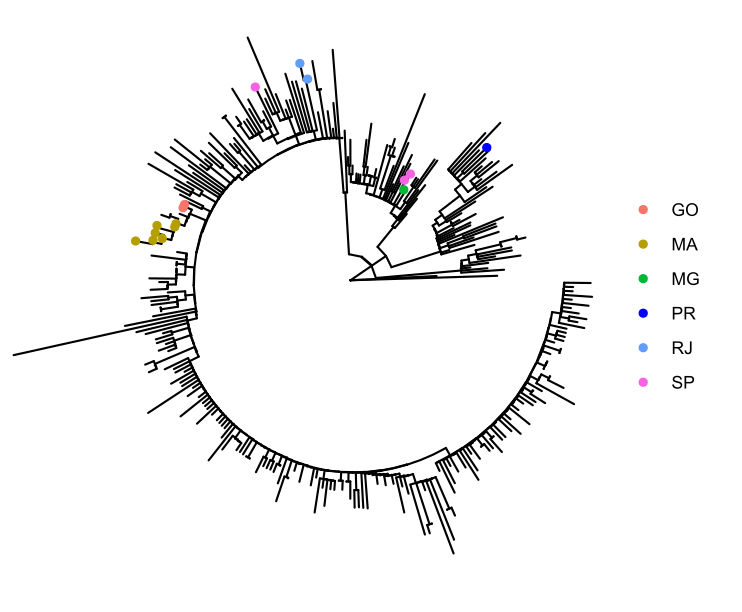
Figure 1. Evolutionary relationships of the two B.1.167.2 genomes from the state of Rio de Janeiro suggests that they are originated from a new introduction of the lineage in Brazil. Brazilian sequences are indicated by points, which are colored according to sampling location.
We would like to thank all the authors and administrators of the GISAID database, which allowed this study of genomic epidemiology to be conducted properly. A full list acknowledging the authors publishing the data used in this update can be found in the following file:
Acknowledgement_table_gisaid.pdf (48.5 KB)